
Medically reviewed by David Bogue, MD, board-certified plastic surgeon | Last reviewed August 2026
Women choose breast implant removal, or explant surgery, for many different reasons. Some are simply tired of having implants. Others no longer want to worry about rupture or future implant maintenance, have had a change in lifestyle, or have concerns about their health. Whatever the reason, removing the implants is only one part of the decision. The condition of the capsule, the amount of remaining breast tissue, skin laxity, nipple position, and the expected loss of upper breast fullness all affect what the breast will look like afterward.
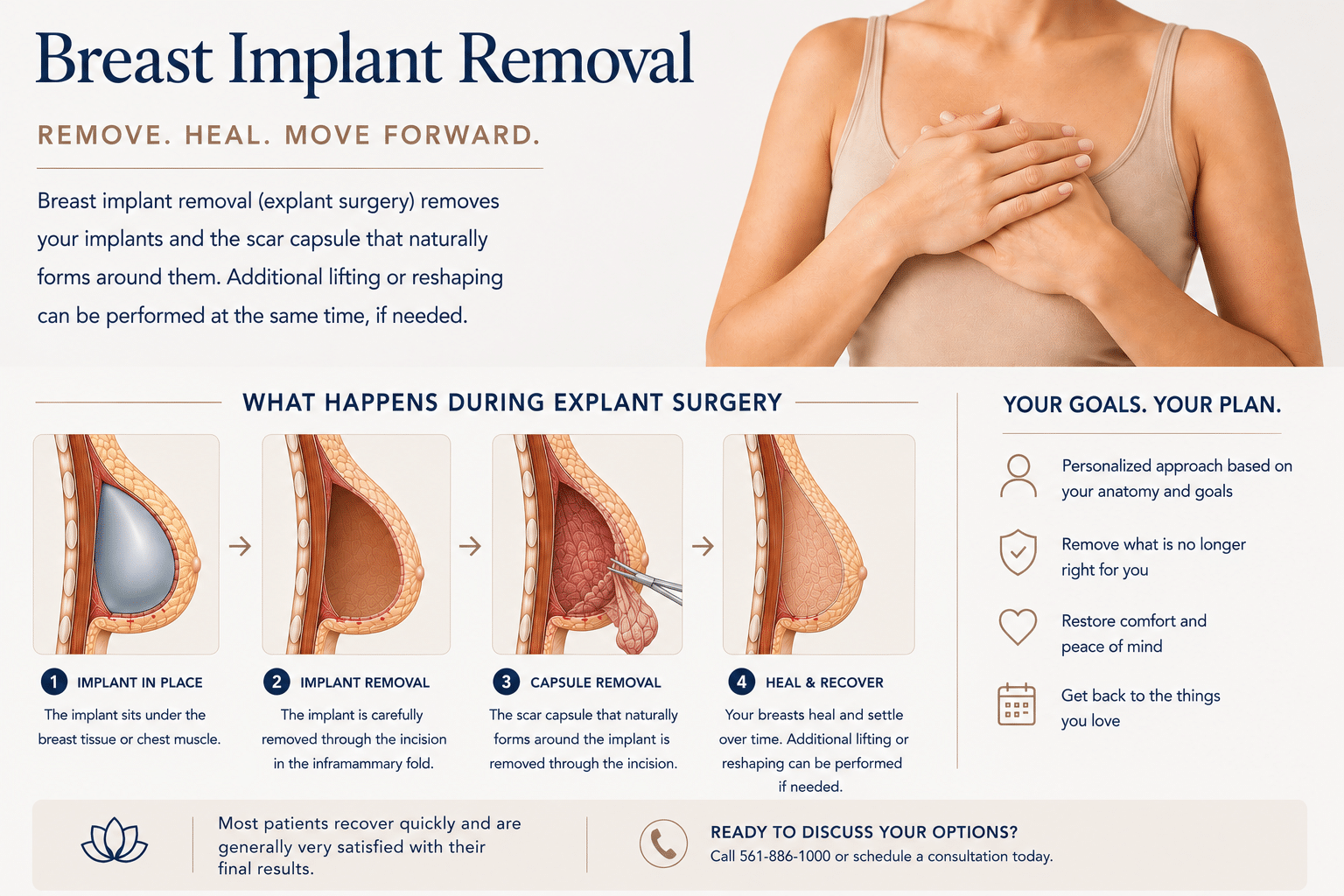
Explant surgery is often presented as a simple operation, but the more important question is what the breast will look like after the implant is gone. Dr. Bogue evaluates the implant, capsule, remaining breast tissue, skin, and nipple position together. The reason you choose to remove your implants does not change his basic surgical approach: he performs a total capsulectomy with explant surgery and plans the operation around the shape of the breast afterward. For many patients, the key decision is whether to remove the implants alone or combine explant with a breast lift to address loose skin and loss of upper breast fullness.
Breast Implant Removal (Explant) FAQs
Will I Need a Breast Lift After Implant Removal?
It depends on how your breasts look with the implants in place and how much of your breast volume comes from the implant. If the nipples are well positioned, the skin is not loose, and there is no significant sagging, the main change after implant removal is a loss of volume. The larger the implant is relative to your natural breast tissue, the more noticeable that change will be, especially in the upper part of the breast.
If the breasts are already sagging or are too large, removing the implants will usually make that more noticeable. Some women still choose implant removal alone because they want to avoid the scars of a lift. Others are better served by combining explant surgery with a breast lift or breast reduction to create a shapelier breast.
This is one of the most important decisions in explant surgery and one where an experienced breast surgeon can make a significant difference. Dr. Bogue evaluates the amount and quality of your remaining breast tissue, skin, nipple position, implant size, and your goals to help you decide whether removal alone or removal with reshaping is the better choice.
“Dr. Bogue is the best!!! He did my breast implant removal. When I first met with him for a consultation, he explained everything to me from start to finish and I barely had any questions left. He made me feel at ease right away. Dr. Bogue recommended that I wait and see if I need a breast lift after the removal procedure and said that most likely I wouldn’t need one and he was right! I am very happy with the final result and I didn’t need to do a lift after.”

Irina Myrick
Google Review
Do You Remove the Scar Capsule During Explant Surgery?
Yes. Dr. Bogue performs a total capsulectomy, meaning the scar capsule surrounding the implant is completely removed. The capsule is then sent to pathology for evaluation.
If needed, the chest muscle is reapproximated to the chest wall, and drains are placed to help prevent fluid accumulation during healing.
What Is En Bloc Breast Implant Removal?
En bloc capsulectomy is a cancer operation in which the implant, capsule, and a margin of surrounding tissue are removed together. It is not the recommended approach for routine explant surgery. A 2024 breast-surgery consensus statement involving representatives from both the American Society of Plastic Surgeons and The Aesthetic Society states that en bloc capsulectomy is indicated for known or suspected implant-associated cancer after appropriate evaluation.
Dr. Bogue does not perform en bloc removal for routine explant surgery because it is unnecessary and can require a much larger incision, increase the risk of injury to surrounding tissues, and potentially cause deformity. Instead, he removes the implant first through a controlled opening and then performs a total capsulectomy.
What Is Breast Implant Illness (BII)?
Breast implant illness (BII) is a term used to describe a group of systemic symptoms reported by some women with breast implants, including fatigue, “brain fog,” muscle or joint pain, and other symptoms. The cause is not well understood, and there is currently no specific test that confirms BII. Other possible medical causes of these symptoms should also be considered.
Some women report that their symptoms improve after their implants are removed, while others do not. Dr. Bogue takes these concerns seriously but does not promise that explant surgery will resolve systemic symptoms. If you choose implant removal because of health concerns, the reason for removal does not change his surgical approach to the explant and total capsulectomy.
What If I Have Textured Breast Implants?
Textured breast implants have a higher association with BIA-ALCL than smooth implants. When Dr. Bogue removes textured implants, he sends the capsule to pathology and specifically requests evaluation for BIA-ALCL.
If you have symptoms such as persistent swelling, a new breast mass, pain, or fluid around the implant, additional evaluation may be needed before explant surgery because suspected or confirmed BIA-ALCL changes how the operation should be performed.
Can I Get Breast Implants Again After Explant Surgery?
Yes. There is nothing about explant surgery that prevents you from having breast implants again in the future. Some women are happy without implants, while others later decide that they miss the volume or shape implants provided.
Reaugmentation is generally straightforward. Dr. Bogue can evaluate the breast after it has healed and discuss implant size, position, and whether any additional reshaping would be helpful.
How Long Is Recovery After Breast Implant Removal?
Recovery from explant surgery is generally easier than recovery from the original breast augmentation. Most patients have relatively mild discomfort and are able to increase activity gradually over the first couple of weeks.
If a breast lift or reduction is performed at the same time, the recovery is usually influenced more by that additional procedure than by the explant itself.
The breasts also continue to change after surgery. Early loss of volume and indentations in the upper part of the breast often soften considerably over time as the tissues settle and heal. Many women find that their final breast shape is quite satisfactory once this process is complete.
How Much Does Breast Implant Removal Cost?
The cost of explant surgery depends on whether the implants are removed alone or whether a breast lift, reduction, or other reshaping procedure is performed at the same time. You will receive an individualized surgical estimate after your consultation.
Pathology is usually covered by insurance. Some insurance plans may also cover implant removal when there is a documented rupture or painful capsular contracture. Coverage generally does not extend to a lift or reduction performed for breast reshaping, although insurance coverage for the medically necessary portion can still reduce your overall out-of-pocket cost.
Breast Implant Removal (Explant) Before & After


Ready To Discuss Breast Implant Removal?
If you are considering explant surgery, Dr. Bogue can help you understand what to expect after implant removal and whether removal alone or additional breast reshaping is the better option for you.